By Hyrum Higgins | January 29, 2022
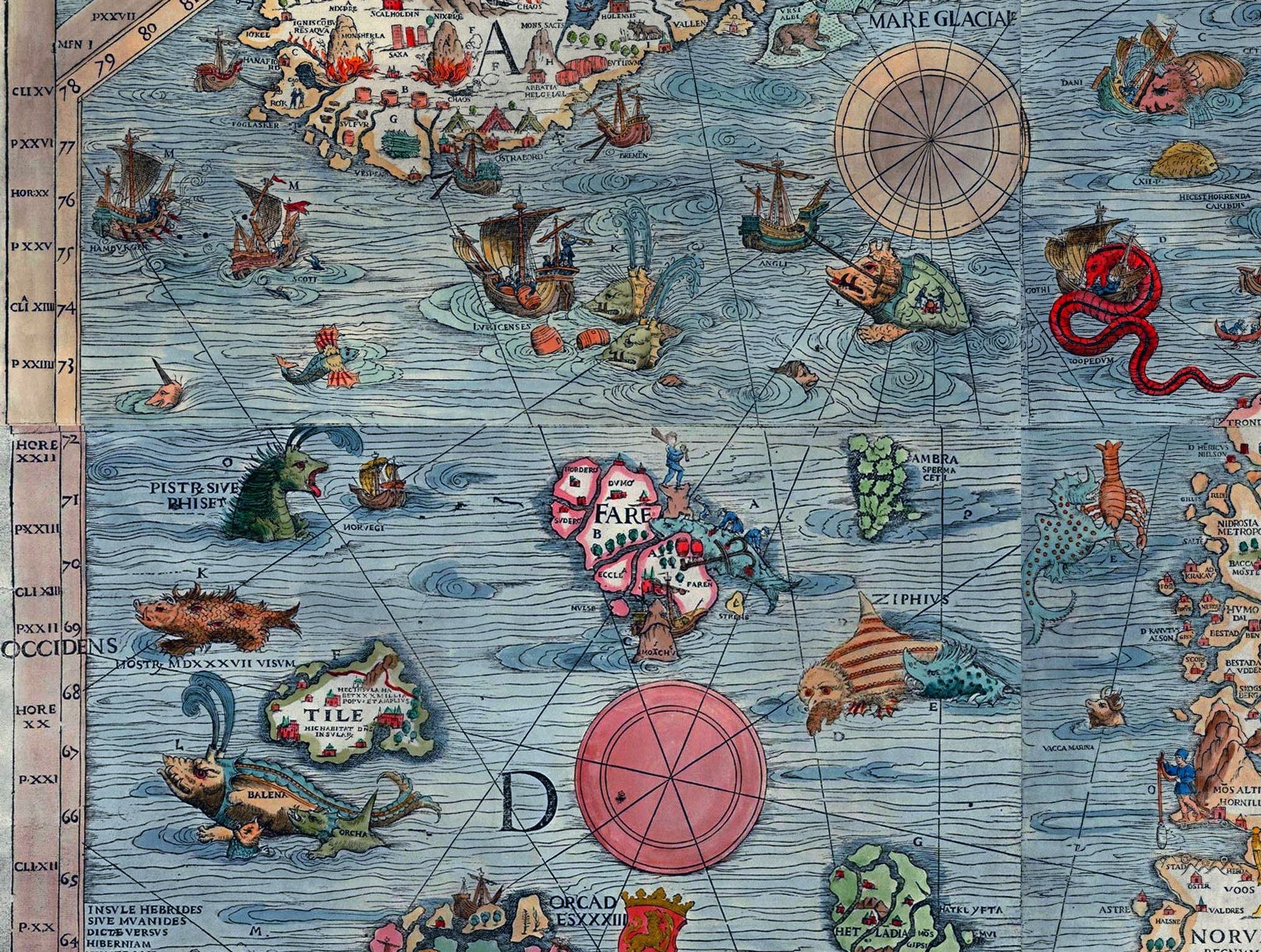
The ocean is filled with fantastical beasts in Olaus Magnus’ 16th-century map of Scandinavia. A sea pig basks off the coast of the mythical island of Thule. A sea serpent crushes a carrack between its coils. Today, it may strike us as strange to see mythical creatures covering a map, but in Medieval and Renaissance times it was normal. To understand why, we need to understand the context in which these fascinating maps were created.
In modern times, it’s easy for us to search for any map we want, but in antiquity, maps were items of great value. Maps were not merely useful; they were works of art. They had to be meticulously drawn by hand, a feat which required a person of rare skill—a cartographer. Cartographers focused on mapping coastlines to aid in navigation. To increase the value of their maps, they decorated the interior of the continents and the expanse of the seas.((https://www.livescience.com/39465-sea-monsters-on-medieval-maps.html)) One of the main ways that they chose to decorate the regions they mapped was with the creatures they believed dwelt there.
In an era before photography, widespread literacy, and modern science, the line between myth and fact was blurred. Very few people were able to travel the world, and verifying stories of far-away realms could be a difficult task. To a 16th-century European cartographer, a rhino or a gorilla must have seemed about as easy to believe in as a dragon or a griffon. When explorers sailed to the new world, they brought back stories of dog-nosed cannibals((Sir Walter Raleigh, 1596, in The Discovery of Guinea http://web.as.uky.edu/history/faculty/myrup/his206/Columbus%20-%20Journal%20of%20the%20First%20Voyage.pdf)) and men with faces on their torsos.((Christopher Columbus, Journal of the First Voyage of Columbus (during his first voyage, 1492-1493) https://www.gutenberg.org/files/2272/2272-h/2272-h.htm)) People of the past were not illogical or dumb for believing in mythological beasts. Their beliefs were shaped by the information they had access to. While many of the beasts portrayed on Renaissance maps were mythical, many were not, and in these maps orcas, walruses, whales, and narwhals shared the waters with mermaids.
The early modern maps filled with legendary animals capture the spirit of a time when the Earth was more mysterious. The cartographers filled in the gaps in their maps with the stories that had reached them and combined that with what was in their own imaginations. These maps give us insight into the worldview of those who braved the open oceans in search of new lands. Weeks away from land, amidst strange waters, how many sailors must have stared at the waves and wondered what strange monsters lay beneath?
 engageglobalstorytelling.com