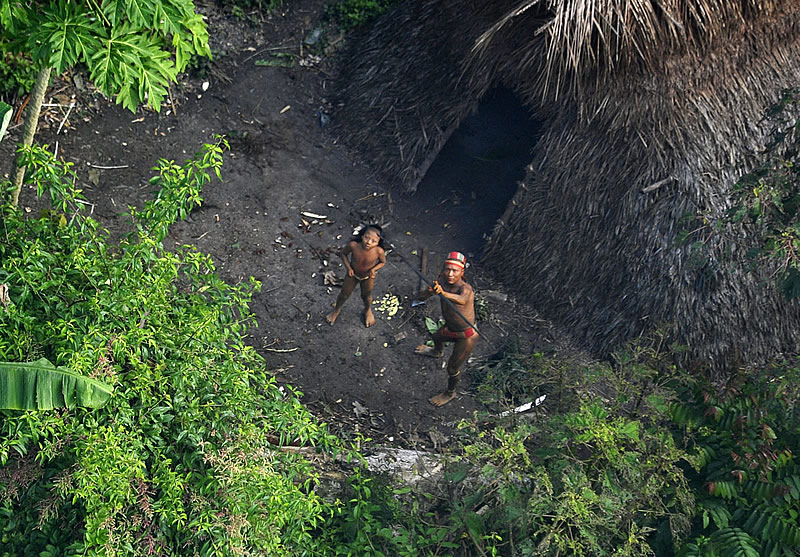
Members of an isolated tribe living in the Amazon Rainforest in Brazil. Photograph by Gleilson Miranda, distributed under the Creative Commons Attribution 2.5 Brazil license.
By Nick Hainsworth
Since the dawn of human civilization, people have been in contact with their neighbors. Human communities have almost never lived in true isolation. In our increasingly global world, humanity has been more connected than ever. We hear of news from across the world almost instantaneously, and we can spread ideas and culture just as quickly. However, there are clusters of people who remain isolated from the rest of the world. Who are these people? Why are they isolated? What can they teach us about geography?
There are clusters of isolated peoples in Papua New Guinea and islands near India, but most live in the Amazon Rainforest, particularly Brazil. Generally, isolated peoples have chosen to live without contact with the outside world. This includes people who have previously had sustained contact but now live in isolation. Sometimes isolated peoples are referred to as “uncontacted peoples.” While it may be true that there are still some people who have never had contact with the modern world, it is unlikely that there are groups of people entirely unaware that there is a much larger world outside of their own community. Whether they’ve heard of larger civilization from a neighboring people, live near a local town or village, or have seen a plane flying overhead, isolated peoples are generally aware of larger civilization around them.[1]
Why, then, do isolated people remain isolated? There are likely several factors, but remembering the history of colonization might be helpful. Take the Indigenous peoples of the Americas. When Europeans first came to the Americas, they brought with them diseases from which Indigenous people had no immunity, killing 90% of the population.[2]Additionally, Europeans enslaved large portions of the Indigenous population, using them to exploit the land. As recently as the 1960’s and 70’s, Brazilian cattle ranchers killed nearly an entire tribe of Indigenous people in the Amazon Rainforest, establishing ranches on their land. One man remains, living alone and attacking any person that comes close to his home.[3] With this history, it likely that fear is the motivating factor for isolated peoples to remain so.
Isolated peoples are a fascinating case study on physical and human geography, including the debate around a peoples’ right to self-determine. Isolated peoples do not use complex agriculture but are generally hunter-gatherer peoples. This could give us insight into past communities and the different ways in which they lived in their surrounding environment. However, this can feed an unhealthy modern, colonial fascination with “primitive people” and disrespect their right to remain isolated. Such was the case with a Christian missionary who was killed after illegally contacting the Sentinelese people living on an island near India.[4] Isolated peoples are a reminder that humans’ relationship with the land and each other is often fraught, complicated, and ever-evolving.
[1] https://www.bbc.com/future/article/20140804-sad-truth-of-uncontacted-tribes
[2] https://www.pbs.org/gunsgermssteel/variables/smallpox.html
[3] https://www.survivalinternational.org/articles/3105-the-last-of-his-tribe
[4] https://www.gq.com/story/john-chau-missionary-and-uncontacted-tribe
 engageglobalstorytelling.com