By Nick Hainsworth
Have you ever wondered how it came to be that there are humans all over the earth? How is it that one species managed to find itself in virtually every spot of land on the planet? The answer is a geographic one. We owe the diversity (or in some instances, the lack thereof) of the human species to geographic and environmental that shaped how humans moved and where they settled. In this three-part bog series, we’ll take a deep dive into the story of Homo sapiens and the implications of our species’ migrations.
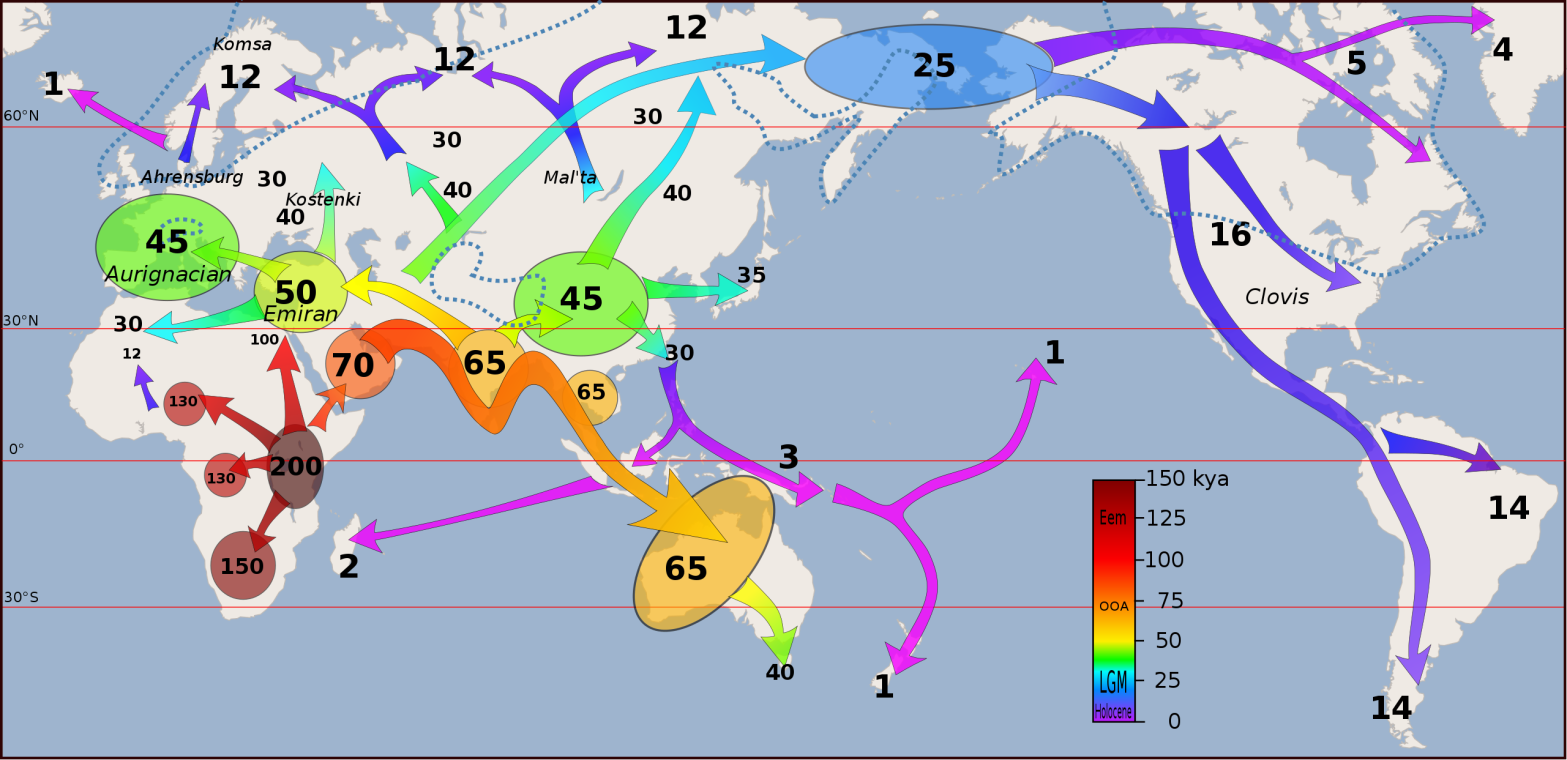
The species we know today as Homo sapiens emerged around 300,000 years ago in Africa. For thousands of years, humans migrated throughout Africa and even out of Africa to what we know today as the Middle East. Scholars debate whether these early migrations led to lasting settlements.[1] Earlier ancestors of Homo sapiens made it even farther, though we know these did not survive. A prominent theory suggests that a group of 150 to 1,000 individuals migrated out of Africa around 70,000-50,000 years ago, and it was this group that led to the spread of humans across the world.
What caused these humans to migrate? Why didn’t these groups hunker down in their corner of East Africa and live out the next hundred thousand years? What would motivate them to move?
Migration is a dangerous task, and probably not taken up spontaneously (though the possibility is always there). Humans need food and water to survive, and so their migration is largely dependent on the best sources of food and water. During periods of receding ice age, deserts can receive much more rainfall. This rainfall can form “green corridors,” where plants grow in greater abundance, leading to a higher population of herbivores. If large herbivores moved into these green corridors, it’s possible that humans followed to hunt, finding themselves in the Levant and Arabian Peninsula.[2]
However, geological evidence suggests that rather than green corridors, the region was likely in the midst of an ice age 70,000-50,000 years ago, which would have made the migration extraordinarily difficult. It’s also possible that instead of trying to follow food sources through green corridors, our migrating ancestors were attempting to escape the arid effects of this ice age in their home.
From the Levant and the Arabian Peninsula, human migration spread to east modern-day India, China, west to Europe, and north to Russia. Thanks to further changes in climate, humans crossed a land bridge to populate the Americas. Brave sea-explorers peopled the islands of the Pacific. From that first group of 150-1,000 people, the world outside of Africa was settled by Homo sapiens.
[1] https://www.sapiens.org/biology/early-human-migration/
[2] https://www.discovermagazine.com/planet-earth/why-did-early-humans-leave-africa
 engageglobalstorytelling.com